
Disposable Medical Sensors Market Size to Reach USD 23.69 Billion by 2035
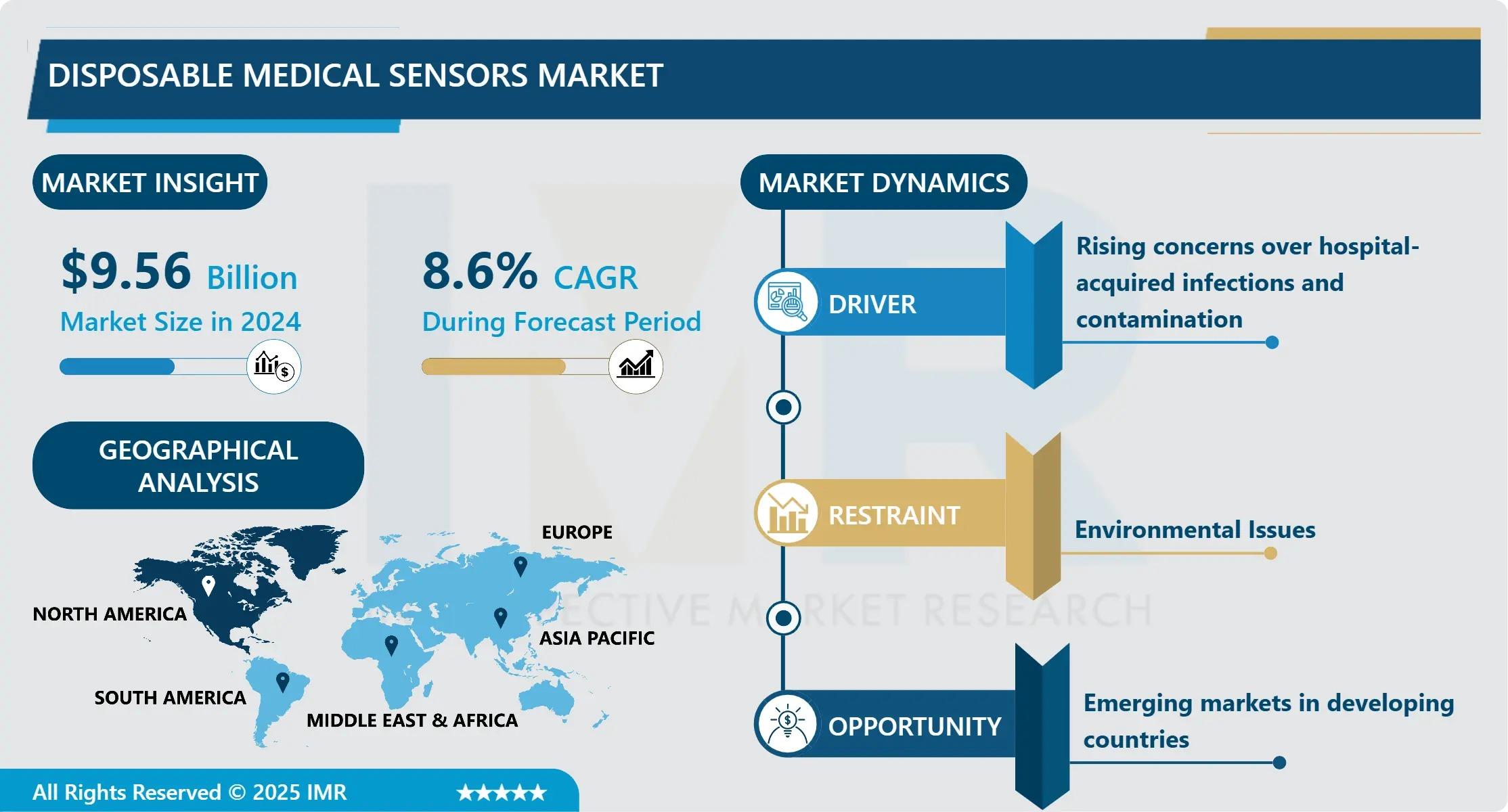
"According to a new report published by Introspective Market Research, Disposable Medical Sensors Market by Product Type, Sensor Type, Application, and End-User , The Global Disposable Medical Sensors Market Size Was Valued at USD 9.56 Billion in 2024 and is Projected to Reach USD 23.69 Billion by 2035 , Growing at a CAGR of 8.6% ."
The global Disposable Medical Sensors Market is witnessing rapid expansion as the healthcare industry prioritizes infection control, cost-efficiency, and patient-centric care. Disposable medical sensors are single-use, portable components integrated into diagnostic and monitoring devices to measure vital signs such as heart rate, blood glucose, and oxygen levels. These sensors offer a significant advantage over reusable alternatives by eliminating the risk of cross-contamination and hospital-acquired infections (HAIs), ensuring high levels of sterility and patient safety in critical care environments.
Driven by the global shift toward remote patient monitoring and decentralized healthcare, these sensors have become essential in modern medicine. Their primary advantage lies in their ability to provide real-time, accurate physiological data without the need for complex sterilization processes. Major industries, including clinical diagnostics, home healthcare, and emergency medical services, are increasingly adopting disposable sensor technology to streamline workflows and improve outcomes for patients suffering from chronic conditions like diabetes and cardiovascular disease.
Market Segmentation:
The Disposable Medical Sensors Market is segmented into Product Type, Sensor Type, and Application. By Product Type, the market is categorized into (Biosensors, Accelerometers, Pressure Sensors, Temperature Sensors, Image Sensors, and Others). By Sensor Type, the market is categorized into (Strip Sensors, Wearable Sensors, Invasive Sensors, and Ingestible Sensors). By Application, the market is categorized into (Diagnostic Testing, Patient Monitoring, Therapeutics, and Imaging).
Growth Driver:
Rising Global Prevalence of Chronic Diseases: A primary driver for the market is the escalating burden of chronic diseases, particularly diabetes and cardiovascular disorders, which require continuous and precise monitoring. For instance, the growing diabetic population worldwide has led to a surge in demand for disposable blood-glucose test strips and continuous glucose monitoring (CGM) patches. These single-use sensors allow patients to manage their health effectively from home, reducing the frequency of hospital visits. As the geriatric population grows—a demographic more susceptible to long-term health issues—the reliance on disposable sensors for routine vital sign tracking is expected to intensify globally.
Market Opportunity:
Advancements in AI and Internet of Medical Things (IoMT): The emergence of "Smart Healthcare" and the integration of Artificial Intelligence (AI) with the Internet of Medical Things (IoMT) present a lucrative opportunity for market players. Innovations in AI-powered disposable sensors allow for predictive analytics and advanced health alerts, shifting healthcare from reactive to proactive care. These sensors can now transmit real-time data to cloud platforms, enabling healthcare providers to monitor patients remotely and intervene before a medical emergency occurs. As sensor miniaturization continues and wireless connectivity becomes more affordable, the potential for multi-parameter disposable patches is expected to redefine the remote monitoring landscape.
Detailed Segmentation:
Disposable Medical Sensors Market, Segmentation The Disposable Medical Sensors Market is segmented on the basis of Product Type, Sensor Type, and Application.
Product Type The Product Type segment is further classified into Biosensors, Accelerometers, Pressure Sensors, and Others. Among these, the Biosensors sub-segment accounted for the highest market share in 2024. This dominance is attributed to their critical role in detecting biological markers for conditions like diabetes and infectious diseases. Biosensors are the cornerstone of point-of-care testing (POCT), offering rapid results that are essential for timely clinical decision-making. Their increasing integration into wearable patches for continuous monitoring further solidifies their leading position in the global market.
Sensor Type The Sensor Type segment is further classified into Strip Sensors, Wearable Sensors, Invasive Sensors, and Ingestible Sensors. Among these, the Strip Sensors sub-segment accounted for the highest market share in 2024. Strip sensors are widely utilized for blood glucose monitoring, pregnancy testing, and illicit drug screening. Their high adoption rate is fueled by their cost-effectiveness and ease of use in both clinical and home settings. While wearable sensors are growing rapidly due to the trend of digital health, the sheer volume of diagnostic tests performed using strip technology ensures its continued market dominance.
Some of The Leading/Active Market Players Are-
· Abbott Laboratories (USA)
· Medtronic plc (Ireland)
· GE HealthCare Technologies Inc. (USA)
· Koninklijke Philips N.V. (Netherlands)
· Johnson & Johnson (USA)
· Honeywell International Inc. (USA)
· 3M Company (USA)
· Becton, Dickinson and Company (BD) (USA)
· Boston Scientific Corporation (USA)
· Smiths Group plc (UK)
· Dexcom, Inc. (USA)
· STMicroelectronics N.V. (Switzerland)
· Sensirion AG (Switzerland)
· NXP Semiconductors N.V. (Netherlands)
· Omnivision Technologies, Inc. (USA)
· and other active players.
Key Industry Developments
In March 2024 , Stryker Corporation announced a major expansion of its medical device testing and R&D facilities in India, specifically focusing on the development of next-generation sensing technologies for surgical and diagnostic tools.
This expansion aims to leverage regional engineering talent to accelerate the innovation of disposable components used in minimally invasive surgeries. By enhancing its testing capabilities, Stryker seeks to improve the accuracy and reliability of sensors that assist surgeons in real-time tissue analysis and navigation.
In February 2024 , GE HealthCare and Biofourmis entered a strategic collaboration to integrate hospital-grade monitoring into the home environment, utilizing advanced disposable wearable sensors.
The partnership focuses on extending the "care at home" model by combining GE HealthCare's monitoring expertise with Biofourmis' AI-driven analytics. This initiative uses disposable patches to track vital signs, allowing patients to be discharged earlier while maintaining a high level of clinical oversight through remote data transmission.
Key Findings of the Study
· Biosensors lead the market share, accounting for nearly half of the global revenue due to high demand for glucose and infectious disease testing.
· North America remains the dominant region, supported by advanced healthcare infrastructure and rapid adoption of digital health technologies.
· Wearable Sensors are the fastest-growing placement type, driven by the consumerization of healthcare and the rise of telehealth.
The Home Care end-user segment is expanding significantly as providers favor remote monitoring to reduce hospitalization costs.
More Info:- https://introspectivemarketresearch.com/reports/disposable-medical-sensors-market/
About Us
At Introspective Market Research Private Limited, we are a forward-thinking research consulting firm committed to driving growth in the Disposable Medical Sensors Market . With deep insights, strategic solutions, and holistic research, we empower businesses to achieve success and dominance in the global digital health and medical technology industry.
📞 Contact Us Introspective Market Research
Pvt. Ltd. Phone: +91-91753-37569
Email: sales@introspectivemarketresearch.com
Web: www.introspectivemarketresearch.com

 English
 French
 Spanish
 Portuguese
 Deutsch
 Turkish
 Dutch
Dutch
 Italiano
 Russian
 Romaian
 Portuguese (Brazil)
 Greek
Greek
 Arabic