
Linerless Labels Market Size to Reach USD 4.17 Billion by 2035
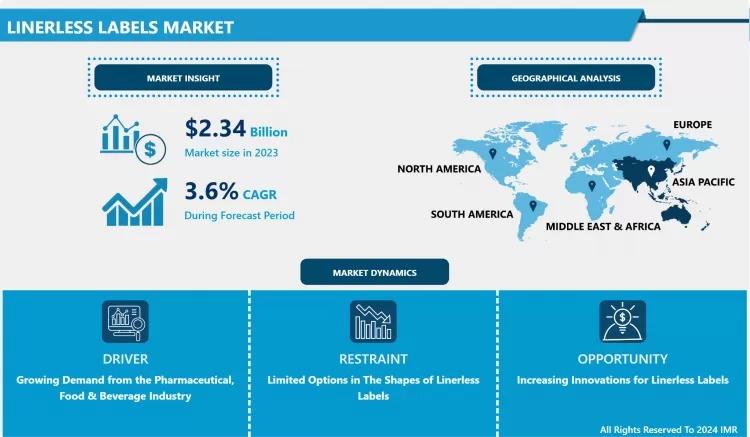
"According to a new report published by Introspective Market Research, Linerless Labels Market by Composition, Product Type, Printing Technology, and End-User , The Global Linerless Labels Market Size Was Valued at USD 2.32 Billion in 2024 and is Projected to Reach USD 4.17 Billion by 2035 , Growing at a CAGR of 5.48% ."
The global Linerless Labels Market is experiencing a robust surge as industries pivot towards sustainable and operationally efficient packaging solutions. Unlike traditional pressure-sensitive labels, linerless labels do not require a backing liner, significantly reducing material waste and environmental impact. This innovative format utilizes a specialized release coating on the face of the label, allowing it to be wound into a roll without sticking to itself. This design not only supports "zero-waste" corporate initiatives but also offers more labels per roll, reducing the frequency of roll changes and downtime in high-speed production environments.
In today's fast-paced logistics and retail landscapes, linerless labels provide a clear advantage over traditional alternatives by lowering shipping weights and storage requirements. These labels are primarily used in weight-scale applications, mobile printing for e-commerce, and high-volume food packaging. As global regulations tighten around single-use plastics and packaging waste, the transition to liner-free technology has become a strategic priority for major players in the food & beverage, pharmaceutical, and logistics sectors.
Market Segmentation:
The Linerless Labels Market is segmented into Composition, Product Type, and End-User. By Composition, the market is categorized into (Facestock, Adhesive, and Topcoat). By Product Type, the market is categorized into (Primary Labels and Variable Information Print (VIP) Labels). By End-User, the market is categorized into (Food & Beverage, Retail, Logistics, and Pharmaceuticals).
Growth Driver:
Sustainability and Waste Reduction Mandates: The primary catalyst for the market is the intensifying global focus on environmental sustainability and the circular economy. Traditional labels generate massive amounts of silicone-coated liner waste, most of which ends up in landfills due to recycling complexities. Linerless labels eliminate this waste stream entirely, directly supporting ESG (Environmental, Social, and Governance) goals. Legislative pressures, such as the EU's Packaging and Packaging Waste Regulation (PPWR), are forcing companies to adopt waste-minimizing technologies. By switching to linerless solutions, businesses can reduce their carbon footprint while simultaneously lowering raw material and waste disposal costs.
Market Opportunity:
Rapid Expansion of E-commerce and Mobile Printing: The meteoric rise of e-commerce presents a significant opportunity for the integration of linerless technology in logistics and warehousing. Mobile linerless printers allow warehouse staff to print variable-length shipping and tracking labels on-demand, optimizing material usage for every package. Unlike fixed-length labels, linerless rolls can be cut to the exact size required for the data, preventing label overlap and reducing material costs by up to 40%. As micro-fulfillment centers and last-mile delivery services grow, the demand for portable, efficient, and liner-free labeling systems is expected to skyrocket globally.
Detailed Segmentation:
Title: Linerless Labels Market, SegmentationThe Linerless Labels Market is segmented on the basis of Composition, Product Type, and End-User.
Composition The Composition segment is further classified into Facestock, Adhesive, and Topcoat. Among these, the Facestock sub-segment accounted for the highest market share in 2024. Facestock typically represents about 80% of the label's total weight and serves as the primary surface for printing. Currently, paper-based facestocks lead the segment due to their cost-effectiveness and biodegradability. However, there is a shifting trend toward film-based facestocks (PP and PET) in the food and beverage industry because of their superior resistance to moisture, oils, and fluctuating temperatures in cold-chain environments.
Product Type The Product Type segment is further classified into Primary Labels and Variable Information Print (VIP). Among these, the Primary Labels sub-segment accounted for the highest market share in 2024. Primary labels are essential for brand identification, decoration, and regulatory information on consumer-facing products. The growth in this segment is fueled by the food and retail sectors, where 360-degree wrap-around linerless labels (sleeves) are becoming popular for meat, fish, and ready-to-eat meals. These labels provide ample space for branding while remaining more sustainable than traditional plastic sleeves or linered labels.
Some of The Leading/Active Market Players Are-
· Avery Dennison Corporation (USA)
· CCL Industries Inc. (Canada)
· 3M Company (USA)
· UPM Raflatac (Finland)
· SATO Holdings Corporation (Japan)
· Multi-Color Corporation (USA)
· R.R. Donnelley & Sons Company (USA)
· Mondi Group (UK)
· Coveris Management GmbH (Austria)
· Herma GmbH (Germany)
· Skanem AS (Norway)
· Ravenwood Packaging (UK)
· Lintec Corporation (Japan)
· Glaston Corporation (Finland)
· Constantia Flexibles (Austria)
· and other active players.
Key Industry Developments
In March 2024, UPM Raflatac announced the opening of a new slitting and distribution terminal in Mumbai, India, specifically to cater to the rising demand for sustainable labeling solutions in the South Asian market.
This expansion allows the company to better serve the rapidly growing Indian e-commerce and retail sectors. By localizing production, UPM Raflatac aims to reduce lead times for its innovative linerless product lines, supporting regional brands in their transition towards a circular economy and reduced packaging waste.
In May 2023 , Avery Dennison Corporation launched its new Avery Dennison Linerless Label series, featuring a high-performance adhesive designed specifically for the Quick Service Restaurant (QSR) and food delivery industries.
The new product line addresses the challenges of "tack" and adhesion in high-moisture and greasy environments. By providing a liner-free solution for order labeling and bag sealing, Avery Dennison helps QSR chains improve operational speed while eliminating thousands of tons of liner waste annually from their global supply chains.
Key Findings of the Study
· Food & Beverage remains the largest end-user segment due to the high volume of packaged convenience foods.
· Asia-Pacific is projected to be the fastest-growing region, driven by massive e-commerce growth in China and India.
· Direct Thermal Printing is the preferred technology for linerless labels in logistics due to its cost-efficiency.
· Adhesive Innovation is a key trend, with new UV-curable and hot-melt formulations improving performance on uneven surfaces.
More Info: https://introspectivemarketresearch.com/reports/linerless-labels-market/
About Us
At Introspective Market Research Private Limited, we are a forward-thinking research consulting firm committed to driving growth in the Linerless Labels Market . With deep insights, strategic solutions, and holistic research, we empower businesses to achieve success and dominance in the global sustainable packaging and specialty materials industry.
📞 Contact Us
Introspective Market Research Pvt. Ltd.
Phone: +91-91753-37569
Email: sales@introspectivemarketresearch.com
Web: www.introspectivemarketresearch.com

 English
 French
 Spanish
 Portuguese
 Deutsch
 Turkish
 Dutch
Dutch
 Italiano
 Russian
 Romaian
 Portuguese (Brazil)
 Greek
Greek
 Arabic